Solution partners

Most bow thrusters sit in a tunnel through the hull. On some boats that is not the best answer, and a retractable thruster, which drops out of the hull only when you need it, does the job better.
Choosing between them is not just about price. It depends on how fast the boat goes, how the bow is shaped below the waterline, how much room there is inside the hull, and how much work you are willing to put into the installation.
How a tunnel thruster works
A tunnel thruster is a propeller in a fixed tube that runs straight through the hull from one side to the other, usually as close to the bow as possible. The motor sits inside the boat on top of the tunnel and drives the propeller through a short gearleg.
It is the simplest way to get sideways thrust, and the most affordable. Nothing has to deploy, there are few moving parts, and the technology is well proven. Tunnel thrusters come in sizes from small boats up to large yachts, with on/off or proportional control, and most boats we fit get one.
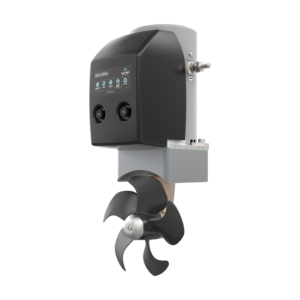
Sleipner SE60 tunnel thruster
Where tunnels have their limits
The tunnel is always there, and that has consequences.
Drag. Under way, water flows past and into the tunnel openings and creates drag. On a displacement boat this hardly matters. On a fast planing boat it costs some speed and fuel. On a sailing yacht it costs performance under sail. Well-shaped tunnel ends help, but they do not remove the drag entirely.
Noise. A tunnel close to the waterline can rumble at speed and bang in a head sea as waves hit the openings.
Placement. A tunnel needs to sit deep enough below the waterline, ideally at least one tunnel diameter, or it draws in air and loses thrust. On hulls where the bottom rises steeply towards the bow, which is common on sailing yachts and many planing hulls, that pushes the tunnel further aft. Further aft means less leverage, so you need more thrust to get the same effect.
How a retractable thruster works
A retractable thruster is built into a housing inside the hull, with a hatch in the bottom. When you switch on the control panel, the unit lowers out of the hull. The propeller still runs in a short tunnel, but that tunnel only exists below the boat while you are using it. When you switch the panel off, the unit retracts and the hatch closes flush with the hull.
Because it lowers below the hull, it is not limited by the shape of the bow in the same way. It can be placed further forward and still have enough water above it. That extra leverage means a retractable often does more with the same power than a tunnel thruster set further aft. When it is retracted, there is nothing in the water: no drag, no tunnel noise and no slamming.
Retractables are available with on/off or proportional control. Most can be fitted at either the bow or the stern.
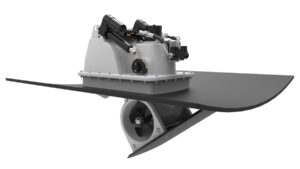
Sleipner retractable thruster lowered
What a retractable asks of the boat
The advantages come at a cost, and not only in price.
- Size range. Sleipner’s electric retractables are designed for boats from around 12 metres. Below that, a tunnel thruster is almost always the practical choice.
- Height inside the hull. Depending on the model, the unit needs roughly 40 to 55 cm of height, plus free space around it for installation and service. Low-profile models exist for boats with limited height, but there still has to be room for it in the bow.
- Weight. A retractable is noticeably heavier than a tunnel thruster with similar thrust, and that weight sits right in the bow.
- Installation. The hull is cut for the hatch, a mounting flange is laminated in, and the area is reinforced. On a new build this is planned in from the start. As a retrofit it is a bigger job than fitting a tunnel, and it has to be done precisely for the hatch to close flush.
- Price. A retractable costs considerably more than a tunnel thruster with similar thrust, and the installation costs more too.
Maintenance
Both types need the usual care: anti-fouling on the gearleg and propeller (not on the anodes), new anodes when they wear down, and a look at the propeller each season.
A retractable needs a little more. Its housing and hatch should also be kept free of fouling, and the hatch and lifting mechanism should be checked to make sure the unit deploys and closes properly. A fouled housing or a hatch that no longer seals flush brings back the drag you paid to avoid.
Which one suits your boat
A tunnel thruster is the right choice for most motorboats, for boats under about 12 metres, for boats that mostly cruise at displacement speed, and for owners who want the simplest and most cost-effective system.
A retractable makes sense when:
- the boat is fast enough that tunnel drag costs speed and fuel
- it is a sailing yacht, where drag under sail matters
- the bow shape means a tunnel cannot sit far enough forward or deep enough
- you want a clean hull with no openings and no tunnel noise under way
On larger yachts the two are often combined, for example a retractable at the bow and a tunnel or external thruster at the stern.
Options at the stern
A stern thruster can go in a tunnel just like a bow thruster, but that is not always possible because of propellers, rudders and shafts. On many boats an external thruster bolted to the transom is easier, since it needs no tunnel through the hull. Retractables can also be fitted at the stern, and on larger sailing yachts they are often the only practical option.
Retractable stern thrusters on larger sailing yachts
On sailing yachts from around 12 metres, stern thrusters are becoming common, and they are almost always retractable.
The shape of a modern sailing yacht explains why. The stern is wide and flat, with very little hull depth aft. A tunnel cannot sit deep enough there to work. The transom is well above the water, so an external thruster bolted to it would not reach the water at all. And a sailing yacht is exactly the kind of boat where an opening in the hull costs performance under sail. A retractable solves all three: it lowers well below the flat aft sections when you need it, and leaves a clean hull when you do not.
The reason to have one is how a sailing yacht behaves in a marina. With a single propeller and a deep keel, it steers poorly in reverse until it has some speed, and prop walk pulls the stern to one side. With high freeboard and a small crew, a crosswind can push the stern off the line long before the lines are on. In Baltic and Nordic harbours, where you often reverse into a berth between posts or moor stern-to, that is exactly when you need control. With thrusters at both ends, you can move the whole boat sideways, hold it in position while lines go on, and leave the berth without relying on the wind.
Finding space is the main challenge. The lazarette on a sailing yacht already holds the rudder bearings, steering, autopilot drive and often a generator. The thruster has to fit in among them, clear of the rudder and the propeller’s wake, so it is often placed slightly off-centre. Because it sits far from the main batteries, it usually gets its own battery near the thruster. Combined with a proportional bow thruster on one control, or a wireless remote, a crew of two can dock the boat from wherever they have the best view.
Before quoting a retractable stern thruster, we check the space aft, the hull structure and the power supply on the boat.
We can help you choose
We are the official Sleipner distributor for the Baltic states and install tunnel, retractable and external thrusters on new builds and as retrofits. For what else to check when choosing a thruster, such as thrust, voltage and batteries, see How to choose a bow or stern thruster. If you are still deciding whether you need one at all, start with Why every boat should have a bow thruster. Sizing, installation and service are covered on our Sleipner page.
Send us your boat’s length, type and cruising speed, and a photo of the bow if you have one, and we will tell you which option fits. Contact us in Tallinn, Riga or Klaipėda.