Description
Volvo Penta Glass Cockpit: most boats use half of what it can do
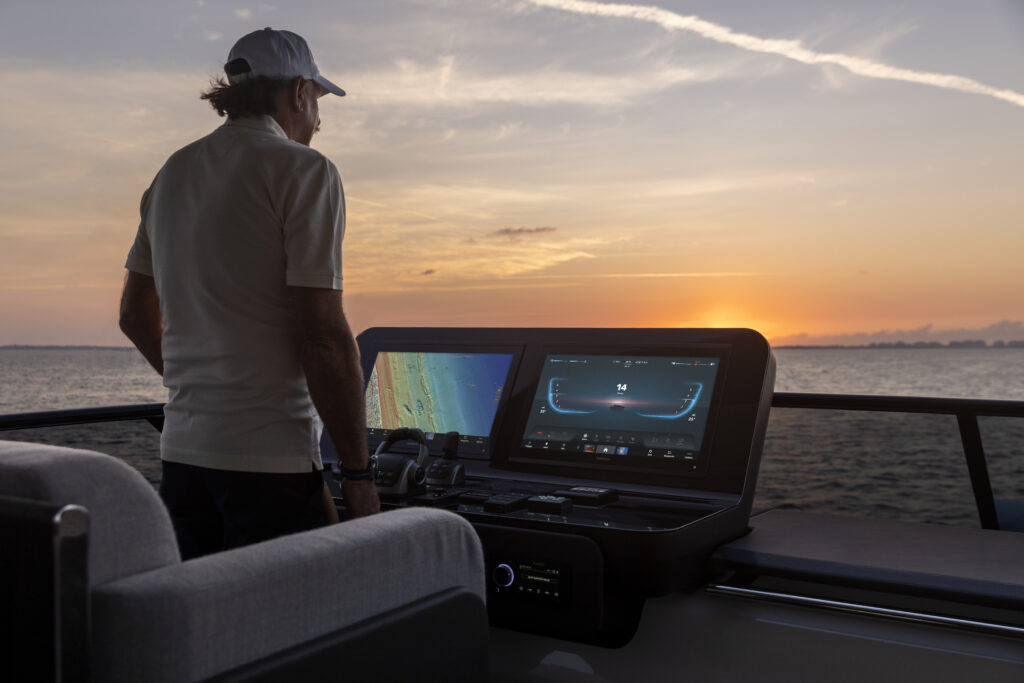
Look at the helm of a new boat with Volvo Penta engines and you will usually find a Glass Cockpit display. Often the smallest screen in the range, mounted off to one side.
It is there for two reasons. It shows engine data, and some Volvo Penta functions will not run without a display on the network. Next to it, doing the actual navigation, sits a different system from a different supplier.
Both work. Neither talks to the other.
What that leaves on the table
The Glass Cockpit was not designed to be an engine gauge. Volvo Penta developed it with Garmin so that one helm could carry the engines, the navigation and most of the rest of the boat on the same screens.
Split the engines onto one system and navigation onto another and you keep the hardware cost but lose the reason for it. Two interfaces to learn. Two places to look. Alarms arriving in two different ways.
The owner paid for a Glass Cockpit and got a digital tachometer.
What a fully integrated helm actually gives you
Engine data where you are already looking. RPM, load, coolant and oil temperatures, battery voltage, fuel burn and trip totals, next to the chart rather than on a panel to one side. Fuel consumption against speed is the one most owners end up watching — it is how you find the cruise setting that gets you there without emptying the tank.
Navigation on the same glass. Charts, radar, sonar, AIS and autopilot, with the engine data overlaid or alongside. No switching between systems while something is happening around you.
Docking you can do alone. Joystick docking turns the drives, throttles and thruster into one control. Assisted Docking goes further and holds the boat against wind and current while you move it — the boat corrects for the gust you did not see coming. Dynamic Positioning holds station while you wait for a bridge or a fuel berth.
Handling at low speed. Low-speed mode for manoeuvring and trolling, cruise control for long legs, trim and interceptor control from the same screen.
One alarm system. Every warning arrives in one place with one logic behind it, instead of two systems beeping about different things and the crew learning to ignore both.
A helm laid out for your boat. Engine data on one screen and chart on another, split views, or a different arrangement for running than for docking. It is configured once to match how the boat is used.
Bringing the rest of the boat onto the same screen
This is the part most owners do not know is possible.
A well-equipped boat carries a lot of gear that each arrived with its own panel. A Seakeeper gyro with its own display. Humphree interceptors with a separate controller. Victron batteries and inverters with a monitor somewhere in a locker. A WhisperPower generator with its own start panel. Tank senders, cameras, switching, lighting.
Most of this can be read from the Glass Cockpit screens instead, and some of it operated there: stabiliser status and spool-up, ride control and trim settings, battery state of charge and consumption, generator hours and load, tank levels, camera feeds.
How far it goes depends on what the equipment can output. Anything with a proper NMEA 2000 interface is usually straightforward. Older or proprietary gear sometimes needs a gateway, and occasionally it cannot be done at all. We look at what is on board before promising anything.
What you end up with is a helm where you look in one place — and a dashboard with far fewer things screwed to it.
Why this needs both Volvo Penta and Garmin
Most installers know one side of it. Engine people know Volvo Penta EVC. Electronics people know Garmin. The integration lives in the gap between them, and that gap is where these jobs stall.
BMG Power Systems is the official Volvo Penta distributor in the Baltic states, and Garmin marine electronics is a core part of our portfolio. The same technicians configure both, frequently on the same boat. That is what makes a Glass Cockpit behave like one system instead of two that happen to share a dashboard.
Retrofit, not just new builds
A good share of our integration work is on boats already in the water.
Owners come to us having bought a boat with a minimal Glass Cockpit install, or with the engines and navigation running separately, and wanting the helm they could have had from the start. In most cases the engines do not need to change at all. The work is in the network and the configuration.
A retrofit normally runs like this:
- audit of what is on board, what can stay and what can be brought onto the network
- network redesign so the systems share data properly
- displays added, moved or replaced
- gateway, CANBUS and EVC configuration
- autopilot tuning, engine and drive calibration, alarm thresholds
- sea trial under real load
What we check before signing it off
We take the boat out. Every propulsion and navigation mode is tested under load. We scan for sources of electrical interference, verify that the network survives a single failure, and check that you can reach what you need without hunting through menus.
Motor cruisers, flybridge boats, sportboats, sailing yachts on saildrive, and the smaller workboats that run the same systems — the equipment list differs, the engineering underneath does not.
Talk to us
Specifying a Glass Cockpit for a new boat, or looking at one where the engines, the navigation and everything else never got connected? We can take it from system design through installation, calibration and commissioning, and support it afterwards.