
Overview
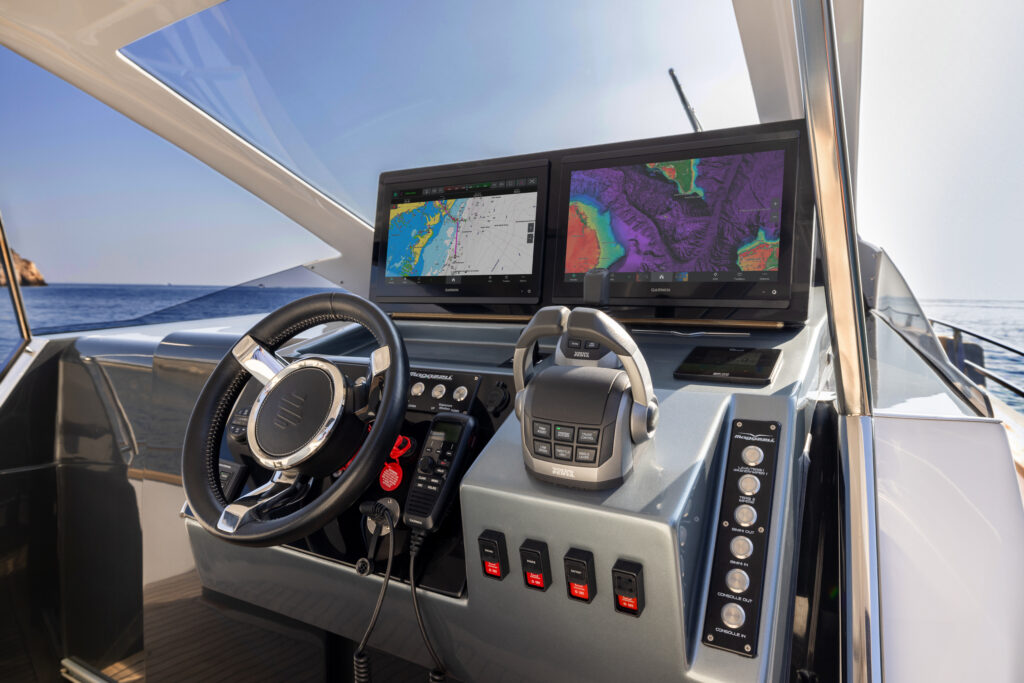
BMG Power Systems is an official Garmin marine dealer. We sell, install and integrate Garmin chartplotters, sonar, radar, autopilots and cameras on boats of every kind, whatever engine is in them. Our sales engineers and installers are trained and certified by Garmin.
Most of the Garmin work we do is on Volvo Penta boats, because we are also the official Volvo Penta distributor for the Baltic states and the two systems are built to work together. But a Garmin upgrade does not need a Volvo Penta engine. If your plotter is ten years old, your sonar shows nothing useful or you want radar on a boat that has never had it, we can help.
Powerful and Intuitive Marine Navigation Systems
GPSMAP chartplotters
The GPSMAP range is the centre of most Garmin helms. Fast, readable in direct sunlight, and running Garmin Navionics+ and BlueChart charts. The plotter is also where everything else on the network shows up — radar, sonar, autopilot, engine data, cameras — so choosing the right size and number of screens is the first decision, not the last.
Sonar
Garmin’s CHIRP sonar, with ClearVü and SideVü scanning, shows a clear picture of what is under and beside the boat. Useful for fishing, for anchoring in unfamiliar water, and for checking depth in places the chart does not quite cover.
What decides whether sonar is any good is mostly the transducer: which one, and where on the hull it goes. A good unit badly mounted shows clutter at speed. That is an installation problem, not a product problem, and it is the most common reason owners are disappointed with their sonar.
Fantom radar
Garmin Fantom is a solid-state radar with Doppler, which colours targets moving towards or away from you. In fog, at night or in a busy fairway that is the difference between seeing an echo and knowing it is a ferry closing on you.
VHF radio
A fixed VHF is the one piece of electronics on board that is about other people rather than about you. It is how you call the harbour, talk to another boat and raise the alarm when something goes wrong.
Garmin VHF radios with DSC send a distress alert with your position at the press of one button. Connected to the same network as the chartplotter, the radio takes its position straight from the GPS, and a DSC call from another boat shows up on your chart where it came from. We install the radio, set it up with your MMSI number and connect it to the network, so the distress button works the way it should on the day it matters.
AIS
AIS shows other vessels on your chart: their name, course, speed and how close they will pass. In the Gulf of Finland, with ferries crossing between Tallinn and Helsinki through the day and cargo ships in the shipping lanes, that matters on every crossing.
A receiver only shows you the others. A Class B transceiver also sends your own position, so the ferry and the cargo ship see you on their screens too. On a Garmin helm, AIS targets appear on the chart and on the radar picture, and the plotter warns you when something is set to pass closer than you want.
Autopilot, cameras and the rest
Garmin autopilots, cameras, instruments and sensors share the same network as the plotter, so they are operated and monitored from the same screens. Equipment from other makers can often be brought onto the network too, depending on what it outputs.
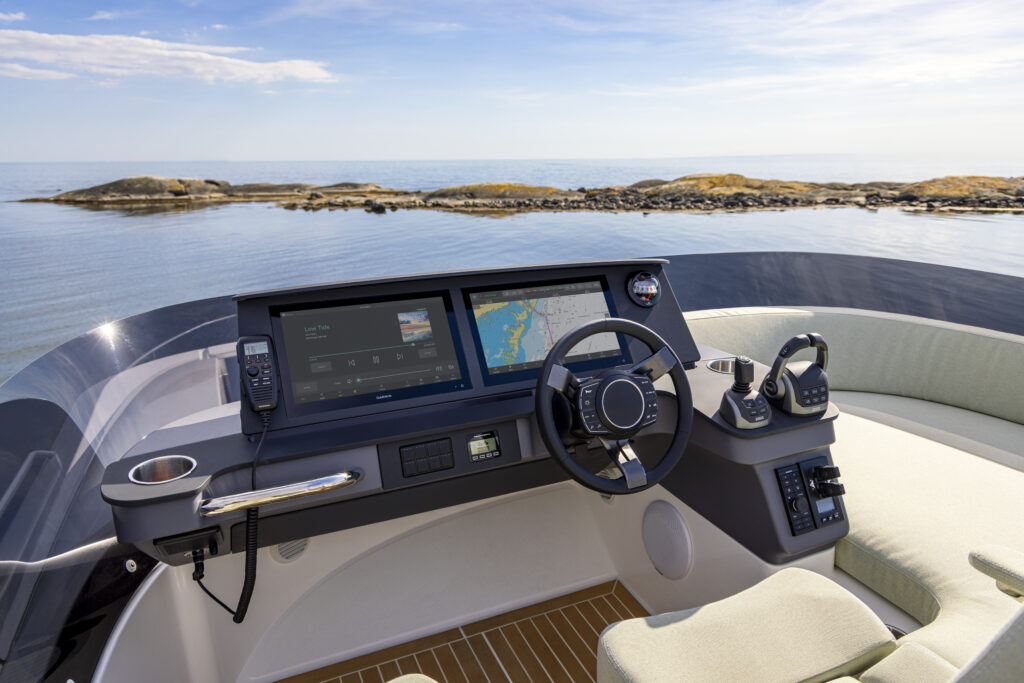
Garmin and Volvo Penta: the Glass Cockpit
Volvo Penta and Garmin developed the Glass Cockpit together. It puts Volvo Penta EVC engine control and Garmin navigation on one set of displays, and adds features such as Assisted Docking and joystick control to the same helm.
Many boats leave the yard with only part of it connected. We wrote about what that costs, and how we fix it, on our Volvo Penta Glass Cockpit integration page.
Installation is where it goes right or wrong
Garmin hardware is reliable. Most problems we are called out to come from how it was fitted: a network that drops data, a transducer in turbulent water, a radar mounted where the mast or arch blocks it, an autopilot that was never calibrated to the boat.
Our installers are Garmin-certified and do this every week. We plan the network before anything is mounted, place transducers and antennas where they work, calibrate the autopilot and compass on the water, and test the whole system on a sea trial before handing it over.
Upgrades and retrofits
A lot of our Garmin work is on boats that are already in use. Replacing an old plotter, adding radar or a second screen, moving to a newer sonar, or bringing everything onto one network so it finally works together. We start by looking at what is on board and what can stay.
Talk to us
Planning electronics for a new boat, or upgrading the helm on the one you have? Call or write to us in Tallinn, Riga or Klaipėda.